Logo

The Future of Real Estate Finance ™

2026 Real Estate Finance Canada

November 10th, 2026 | Deloitte Canada, Toronto
View Agendaarrow_forward

About This Event

The 2026 Real Estate Finance Canada conference is the premier summit for Canadian real estate finance executives. This dedicated forum will explore the issues reshaping real estate finance, with a deep dive into industry modernization, mortgage and real estate-secured lending innovation, digital transformation, AI, risk, fraud, regulation, origination, servicing, capital flows, and the broader challenges and opportunities facing the sector.

Target attendees include senior executives from banks, credit unions, mortgage finance companies, non-bank lenders, insurers, capital providers, and fintechs. Join more than 400 professionals across credit risk, operations, servicing, compliance, and strategy for unparalleled networking and critical debate on the future of Canadian real estate finance.

Past Speakers

Chadwick Westlake CEO
Stephen Smith Chairperson
Scott Wood CEO
Patrick Ens CEO
Malik Yacoubi CEO
Justin Herlick CEO | Founder

Sponsors

Deloitte

Draft Agenda

Call-for-speakers and sponsors.

Start Early

Call-for-Speakers and Sponsors

Contact sponsor@canadianlenders.org

9:00 - 9:30 Regulation

When the Machine Makes the Mortgage

Agentic AI, OSFI and the future of RESL regulation

As lenders begin to deploy agentic AI across the mortgage value chain, OSFI’s RESL framework faces a new level of complexity. Autonomous tools may soon support document collection, income verification, product recommendation, underwriting, servicing, renewal management, and portfolio monitoring.

This panel examines how AI challenges existing expectations around accountability, explainability, model risk, borrower due diligence, governance, and supervisory confidence. Speakers will discuss what it means to maintain prudent underwriting when parts of the mortgage process are increasingly automated, adaptive, and difficult to explain.

9:30 - 10:00 Fraud

The Fraudsters Have AI Too

AI, synthetic identity and financial crime in RESL

Mortgage fraud is becoming faster, more scalable, and more difficult to detect. Synthetic identities, manipulated documents, deepfakes, mule accounts, inflated income claims, and coordinated fraud rings are converging with AI tools that can generate convincing borrower profiles and documentation at speed.

This panel explores how lenders are modernizing fraud prevention across the real estate secured lending lifecycle. The discussion will cover identity verification, income validation, document intelligence, device signals, behavioural analytics, consortium data, explainability, and the balance between stronger fraud controls and a frictionless borrower experience.

10:00 - 10:30

Morning Schmooze

10:30 - 11:00 AI

The Last Human in the Mortgage Loop

The human role in an AI-driven mortgage journey

The mortgage experience is becoming increasingly digital. Borrowers can search, apply, upload documents, receive recommendations, and move through approval workflows with limited human interaction. But mortgages remain emotionally charged, financially significant, and highly contextual decisions.

This session examines where human judgment still matters. Panelists will discuss advice, exception handling, vulnerable borrowers, broker and advisor roles, complaints, explainability, relationship management, and the moments when automation must give way to human accountability.

11:00-11:30 Affordability

Generation Rent: Buyers Who May Never Buy

The future of home ownership

For many younger Canadians, the question is no longer when they will buy a home. It is whether they will buy one at all. Affordability pressures, income volatility, housing supply constraints, delayed family formation, student debt, climate anxiety, and changing attitudes toward work and mobility are reshaping the traditional path to ownership.

This panel looks beyond affordability alone. Speakers will discuss how Gen Z and younger millennials view home ownership, what lenders need to understand about future demand, and how products, channels, underwriting, savings tools, and public policy may need to evolve for a generation that may not follow the old housing script.

11:30 - 12:00 Risk

The Renewal Reckoning: Cheap Mortgages Are Due

Portfolio health amid the mortgage renewal wall

Many Canadian borrowers who secured low-rate mortgages during the pandemic period are renewing into a materially different rate environment. For lenders, the question is not only whether delinquencies rise. It is how renewal pressure affects borrower behaviour, portfolio performance, credit migration, prepayment, household liquidity, and long-term customer relationships.

This session examines how institutions are monitoring portfolio health through the renewal wall. Panelists will discuss early warning indicators, payment shock, amortization pressure, loss mitigation, IFRS 9 considerations, segmentation, renewal strategy, and how lenders can distinguish temporary stress from structural borrower impairment.

12:00 - 1:00

RESL Network Lunch

1:00 - 1:30 Risk

Uninsurable: Collateral Shock

Insurance, climate and collateral risk

The mortgage system depends on collateral that can be valued, insured, financed, and sold. Climate risk is putting pressure on that assumption. Flood, wildfire, storm, heat, infrastructure failure, and insurance availability are becoming more important to property values and mortgage risk.

This panel examines how lenders, insurers, investors, and regulators should think about collateral when insurance becomes more expensive, less available, or more restrictive. Speakers will discuss property-level climate data, insurance gaps, appraisal risk, geographic concentration, borrower disclosure, stress testing, and whether climate risk will change where and how lenders are willing to lend.

1:30 - 2:00 Private Credit

Private Credit Comes Knocking

The expansion of private credit in real estate finance

As regulated lenders face capital, underwriting, and risk appetite constraints, private credit is becoming a larger part of the real estate finance ecosystem. This can provide flexibility and liquidity, but it also raises questions about transparency, borrower protection, systemic risk, pricing discipline, and the migration of risk outside the regulated perimeter.

This panel explores the growth of private credit in residential, commercial, construction, bridge, and alternative mortgage finance. Speakers will discuss where private capital is filling gaps, how risk is priced, what institutional investors are looking for, and whether Canada needs a clearer view of the shadow mortgage market.

2:00 - 2:30

Afternoon Network Break

2:30 - 3:00 Data

Building the New Mortgage Stack

Data, platforms, brokers, insurers and lenders in a more automated market

The mortgage market is being rebuilt through data connectivity, embedded workflows, open banking, digital identity, automated valuations, income verification, broker platforms, servicing technology, and AI-enabled underwriting. The result is a new mortgage stack that may change who owns the customer, who controls the data, and who carries the risk.

This session examines how the infrastructure of real estate finance is changing. Speakers will discuss the future of broker distribution, lender platforms, insurer integration, data access, third-party dependency, compliance by design, and the operational model needed for faster, safer mortgage decisions.


3:00 - 3:30 Innovation

After the Machine: Real Estate Finance in 2030

In a fast-changing market, looking five years ahead.

The closing leadership roundtable will look beyond today’s cycle and ask what Canada’s real estate finance market could look like by 2030. Will AI become a trusted underwriting partner? Will private credit become mainstream? Will climate risk reshape collateral value? Will home ownership remain the dominant aspiration? Will regulation keep pace with the market?

This discussion will bring together senior executives from across the ecosystem to debate the future market structure. The focus will be on the strategic choices facing lenders, insurers, investors, policymakers, and technology providers as Canada moves toward a more automated, data-driven, risk-sensitive real estate finance system.

3:30 - 5:00

Can I Buy You a Drink?

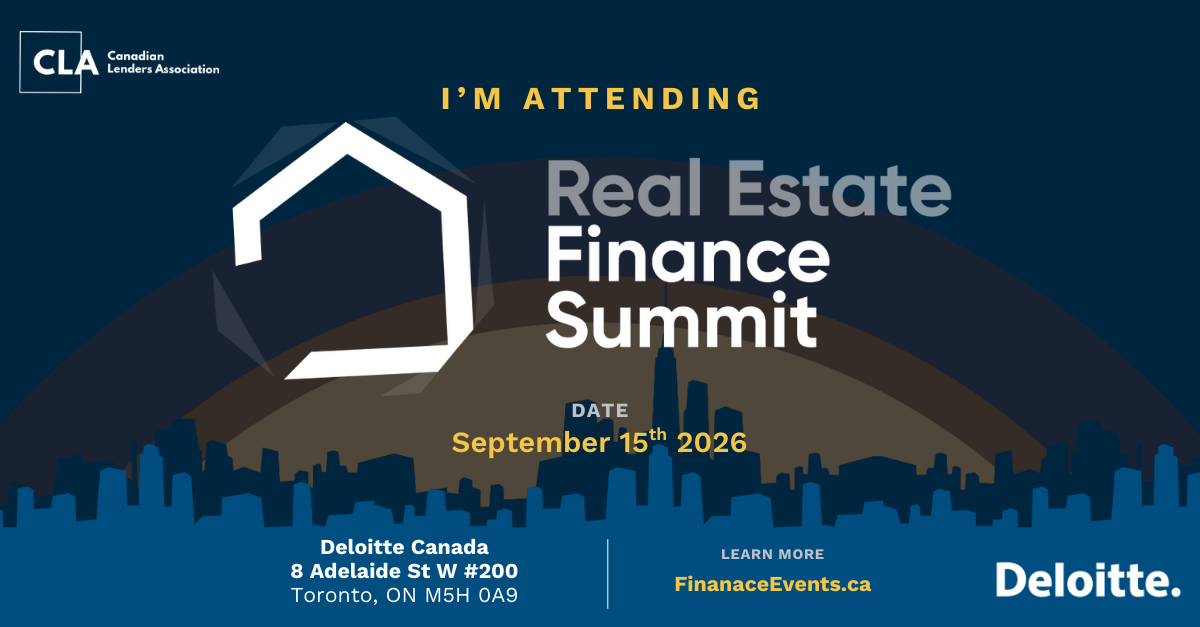
Attending this event?

Join 500+ finance leaders. Let your professional network know you are staying at the forefront of the industry by attending 2026 Real Estate Finance Summit in Toronto.

Share on Linked

Details

Date

November 10th, 2026

Time

8:00 AM - 6:00 PM

Venue

Deloitte Canada, 8 Adelaide St W #200, Toronto, Ontario

Limited Seats

From CAD 500.00