2027 Canadian Finance Summit
Canada’s #1 Fintech Conference
- Date
- June 3, 2027
- 8:00 AM GMT+0000
- Venue
- The Quay, Toronto
The 2024 Sustainable Finance Summit is Canada’s premier forum for financial sector executives dedicated to advancing institutional readiness amidst the global energy transition. The core focus of the one-day event is providing immediate, actionable strategies across key areas: Climate Risk Stress Testing (including deep dives into OSFI B-15 compliance), practical ESG data integration, leveraging AI in risk analytics, and maximizing sustainable investment opportunities. A major highlight of the day will be the launch and workshop surrounding the B-15 Industry Playbook, offering direct guidance on regulatory compliance and positioning organizations to gain a competitive advantage in the rapidly evolving market.
This summit is for C-Suite and Senior Executives leading Risk Management, Investment Strategy, and ESG Compliance at major Banks, Insurers, Pension Funds, and Fintechs. Join over 250 industry leaders and policymakers for unparalleled networking and expert insights on aligning portfolios with net-zero ambitions and building financial resilience.
8:00 - 5:00
Network App
Use the Finance Events Network App to setup meetings in the Securian Networking Hall throughout the day. Schedule time in the network hall. Numbers…
Setting the Stage
10 mins to set the stage for this amazing day. What are the outputs for the summit? How can we advance the room business…
10 mins to set the stage for this amazing day. What are the outputs for the summit? How can we advance the room business and strategic goals?
All panels and workshops will be filmed with A|B cameras and distributed to attendees.
IFRS: Brief on Sustainability Disclosures
Mini-Keynote: Michael Jantzi, is member of the International Sustainability Standards Board (ISSB), working to empower capital market participants with the right information to support better economic…
Mini-Keynote: Michael Jantzi, is member of the International Sustainability Standards Board (ISSB), working to empower capital market participants with the right information to support better economic and investment decision-making. Michael discusses how adopting sustainability disclosures can power transparent and resilient markets.
An Economy in Transition
Aligning financial strategy with net zero is critical for resilience. Learn how to navigate mandatory disclosures and integrate climate goals into your governance.
Aligning financial strategy with net zero is no longer an optional ethical consideration but a fundamental requirement for institutional resilience and market access. This session moves beyond high-level climate pledges to examine the actual scorecard of corporate progress, highlighting that many organizations are still at ground zero regarding substantive implementation. A key insight shared by the panelists is the shift from voluntary narrative reporting to mandatory, audit-ready disclosures that treat carbon as a primary financial metric. By focusing on aligning financial strategy with net zero, leadership teams can move past static target-setting and begin the difficult work of integrating climate-related risks directly into their capital allocation and budgeting processes.
The technical depth of this session explores the evolution of governance frameworks and the critical role of the Canadian Sustainability Standards Board in harmonizing local requirements with global ISSB norms. For professionals tasked with aligning financial strategy with net zero, the discussion provides a roadmap for utilizing data-driven benchmarks to measure performance against transition pathways. This involves not only tracking internal emissions but also assessing the carbon footprint of entire investment portfolios and supply chains. Successfully aligning financial strategy with net zero allows firms to lower their cost of capital while positioning themselves to capture the massive growth opportunities within the emerging sustainable finance ecosystem.
Watch the full panel discussion to gain the practical insights necessary for transforming your organizational scorecard from a statement of intent into a plan for measurable action.
VCM: Quality of Credits & Goals of Purchasers
Scaling voluntary carbon markets effectively is key to global net-zero goals. Learn how to navigate credit quality and purchaser needs to drive climate impact.
Scaling voluntary carbon markets effectively is no longer just about increasing transaction volume; it is about establishing a high-integrity framework that can withstand intense public and regulatory scrutiny. As this session highlights, the transition from a $2 billion niche to a $50 billion climate powerhouse requires a fundamental shift in how quality is defined and verified. The panel experts reveal that the primary barrier to growth is not a lack of capital, but a deficit of trust driven by concerns over greenwashing and inconsistent credit standards. By focusing on scaling voluntary carbon markets effectively, participants can ensure that private finance is successfully channeled into high-impact projects that provide genuine, additional carbon removals rather than just avoided emissions.
The technical discussion explores the necessity of harmonized accounting principles and the role of independent registries in providing the transparency that institutional buyers demand. For those looking at scaling voluntary carbon markets effectively, the session provides deep insights into the evolving expectations of purchasers who are now prioritizing social co-benefits and biodiversity protection alongside carbon metrics. This shift in buyer goals means that the next generation of successful carbon projects must demonstrate rigorous data quality and long-term permanence to command premium pricing.
Mastering the complexities of scaling voluntary carbon markets effectively is essential for any organization aiming to use offsets as a credible component of their broader net-zero decarbonization strategy.
Watch the full panel discussion above to learn how the industry is building the infrastructure necessary to scale impact and accelerate global decarbonization.
Carrots and Sticks: Incentivizing Green
Clean economy investment tax credits are transforming Canadian energy investments. Learn how Bill C-59 and new refundable credits can fund up to 60% of project costs.
Clean economy investment tax credits represent the single most important shift in Canadian fiscal policy for the energy and manufacturing sectors in over a decade. While many organizations are aware of the transition toward net-zero, this session highlights a critical market reality: the refundable nature of these credits means that even pre-revenue firms can receive significant cash infusions to offset capital expenditures. By moving from traditional deductions to these high-value incentives, the federal government has effectively lowered the barrier to entry for massive infrastructure projects in carbon capture and clean hydrogen.
The panel provides a technical breakdown of how Bill C-59 and the subsequent Bill C-15 have codified these incentives into law, offering long-term policy certainty for investors through 2035. Experts discuss the strategic implications of the labour requirements attached to these credits, explaining why failing to meet prevailing wage standards can result in a ten percent reduction in the total credit value. Furthermore, the discussion addresses the interaction between these clean economy investment tax credits and the new anti-greenwashing provisions in the Competition Act, which now require all environmental performance claims to be backed by internationally recognized methodologies.
Navigating the complexities of clean economy investment tax credits requires a proactive approach to contemporaneous documentation and capital planning. As the Canada Revenue Agency moves toward an AI-driven audit system in 2026, maintaining clear technical logs is essential for ensuring expedited processing of claims. This session serves as a vital roadmap for financial leaders looking to maximize their return on investment while contributing to the national sustainability agenda. Understanding the nuances of clean economy investment tax credits is no longer just a tax function but a core component of competitive corporate strategy.
Key session takeaways include:
Watch the full panel discussion to learn how to effectively leverage clean economy investment tax credits for your next major project.

Morning Schmooze
NETWORK MEETINGS: Use the Sustainable Finance Summit App to setup multiple one-on-one sessions in the networking hall. Scheduled meetings correspond to table numbers. Establish the partnerships…
NETWORK MEETINGS: Use the Sustainable Finance Summit App to setup multiple one-on-one sessions in the networking hall. Scheduled meetings correspond to table numbers. Establish the partnerships that will advance your business in 2025. (unlimited)
Your OSFI Playbook: Data Needs, Data Models, Data Templates
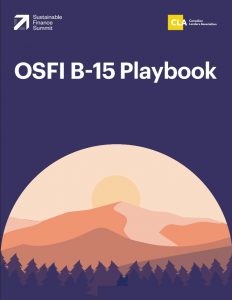
Workshop A: The CLA launches its B-15 Playbook. Discuss how best to streamline your OSFI data return template workflow in this hands-on workshop. Learn…
Workshop A: The CLA launches its B-15 Playbook. Discuss how best to streamline your OSFI data return template workflow in this hands-on workshop. Learn how to transition seamlessly from defining data needs to constructing data models. Gain insights into automating template population to enhance efficiency and accuracy. Perfect for risk and ESG officers looking to optimize their reporting processes. (80 capacity)
Capital as Catalyst: De-risking & Upscaling Local Initiatives
Workshop B: This workshop dives into the need, opportunities, and stories of strategic partnerships between local governments and private investors in tackling climate change…
Workshop B: This workshop dives into the need, opportunities, and stories of strategic partnerships between local governments and private investors in tackling climate change and other sustainability challenges. Hear from private/public partnerships and discover how local governments and private organizations can help safeguard communities of all sizes for the future.
Learn how FCM sets projects up for success and helps de-risk opportunities for private sector investment. FCM’s Green Municipal Fund is a leading and trusted funder of sustainable projects and infrastructure. For nearly 25 years, GMF has helped local governments adopt high-performing and scalable climate solutions, from district energy systems to innovative financing models for home energy upgrades. It has also played a key role in accelerating partnerships between municipalities and the investment and financial sectors. (30 capacity)

The Great SME Decarb: When, Why and How
Workshop C: How can financial institutions harness sustainability expertise and fit-for-purpose technologies to drive value-added client engagement strategies. This workshop focuses on supporting SMEs…
Workshop C: How can financial institutions harness sustainability expertise and fit-for-purpose technologies to drive value-added client engagement strategies. This workshop focuses on supporting SMEs in their decarbonization journey. Discover the critical timing, motivations, and methodologies for effective decarbonization. Ideal for risk and ESG officers aiming to champion sustainable practices. (15 capacity)
Network Lunch
Our Net Zero Scorecard: Ground Zero?
Panel Main Theatre: This panel examines Canada’s journey toward net-zero emissions by 2050, spotlighting the critical role of financial institutions. Experts will discuss how…
Panel Main Theatre: This panel examines Canada’s journey toward net-zero emissions by 2050, spotlighting the critical role of financial institutions. Experts will discuss how they are integrating climate goals into their strategies, driving sustainable finance, climate engagement strategies and overcoming challenges. Learn how the financial sector is shaping Canada’s low-carbon future and aligning with national sustainability objectives.
Green Intelligence: Can we bank on AI?
Panel Main Theatre: Can we unlock the power of AI in sustainability? This panel explores AI’s potential beyond process automation in the banking sector.…
Panel Main Theatre: Can we unlock the power of AI in sustainability? This panel explores AI’s potential beyond process automation in the banking sector. Leaders from both banks and non-banks will discuss innovative AI-powered sustainability practices. Learn how AI can drive transformative changes and enhance sustainability efforts. Join us for insights on the future of AI in banking and sustainability.
(Actually Using) Climate Stress Testing & Scenario Analysis
Panel Main Theatre: How can we advance climate stress testing beyond compliance? This panel will explore ways to accelerate business usage and integration of…
Panel Main Theatre: How can we advance climate stress testing beyond compliance? This panel will explore ways to accelerate business usage and integration of scenario analysis. Experts will share insights on leveraging these tools for strategic decision-making. Discover how to turn regulatory requirements into opportunities for innovation. Ideal for risk and ESG officers seeking to deepen their climate resilience strategies.
Afternoon Schmooze
NETWORK MEETINGS: Use the Sustainable Finance Summit App to setup multiple one-on-one sessions in the networking hall. Scheduled meetings correspond to table numbers. Establish the partnerships…
NETWORK MEETINGS: Use the Sustainable Finance Summit App to setup multiple one-on-one sessions in the networking hall. Scheduled meetings correspond to table numbers. Establish the partnerships that will advance your business in 2025. (unlimited)
Climate Risk Stress Testing: The Good, Bad and the Ugly
Workshop A: Navigate the complexities of transition risk modeling with confidence in this hands-on workshop. Learn to mature your capabilities strategically to drive business…
Workshop A: Navigate the complexities of transition risk modeling with confidence in this hands-on workshop. Learn to mature your capabilities strategically to drive business value. Explore the good, bad, and ugly aspects of transition risk stress testing. Gain practical insights to enhance your risk management strategies. Perfect for risk and ESG officers looking to strengthen their approach to transition risks. (80 capacity)
Next-Gen Credit Risk Assessment & Risk Management
Workshop B: With thought-leaders joining us from Canada, Europe and US, we explore the dynamic evolution of credit risk assessment processes in this interactive…
Workshop B: With thought-leaders joining us from Canada, Europe and US, we explore the dynamic evolution of credit risk assessment processes in this interactive workshop. Understand the power of integrating ESG ratings to enhance risk management strategies, while also delving into the intersection between ESG, financial crime, KYC, and compliance. Learn how next-gen tools and methodologies are transforming credit risk evaluation and ensuring alignment with regulatory requirements. Gain insights from industry experts on best practices and emerging trends. Ideal for risk, ESG officers, and compliance professionals aiming to innovate their credit risk frameworks. (30 capacity)
The ES in G: Sustainable Disclosures in Governance
Workshop C: Set the stage for effective governance with sustainable disclosures in this workshop. Learn to make sustainability disclosures a routine part of your…
Workshop C: Set the stage for effective governance with sustainable disclosures in this workshop. Learn to make sustainability disclosures a routine part of your business operations. Explore best practices for integrating ESG factors into governance frameworks. Enhance transparency and accountability in your organization. Ideal for risk and ESG officers committed to advancing sustainable governance practices. (15 capacity)
Can I Buy You a Drink?
End-of-day drinks and networking.